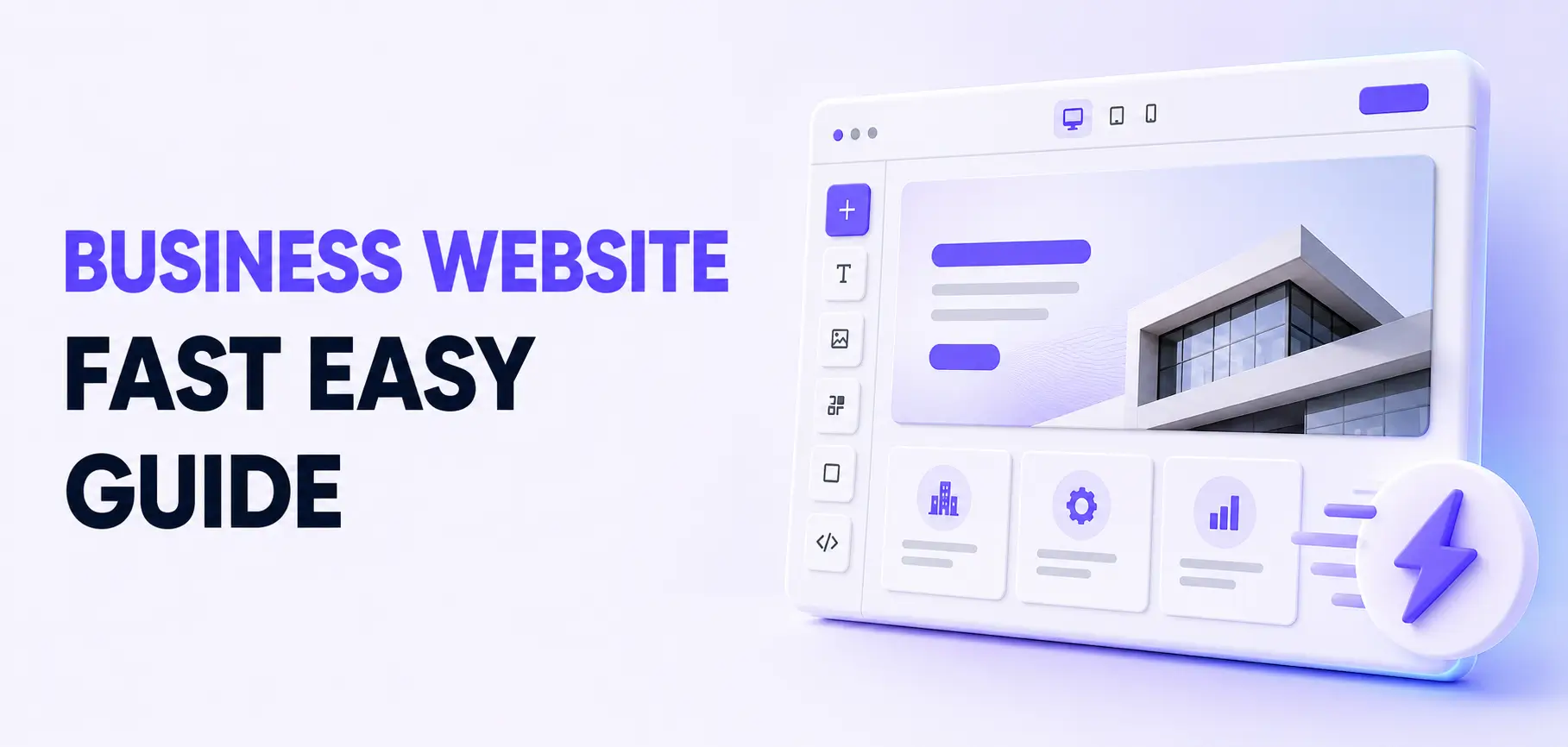

Building a professional business website no longer requires advanced coding skills. With WordPress, Elementor, and the right design tools, you can create a website that builds trust, generates leads, and supports your long-term business goals.
This guide explains how to build a website for a business from planning to launch. You will learn how to choose a platform, register a domain, select hosting, plan essential pages, design with Elementor, add useful features, optimize for search engines, estimate costs, and maintain the finished site.
Quick Answer: To build a business website, define your goal, choose a platform, register a domain, select hosting, create pages, add content, optimize SEO, test, and launch. For beginners, WordPress with Elementor provides a flexible visual workflow without coding. HT Mega can speed up the design process with additional widgets, templates, and Theme Builder controls.
Table of Contents
Why Your Business Needs a Website
A business website is your central online destination. Social profiles can support your marketing, but your website gives you greater control over your content, branding, customer journey, and conversion process.
A well-planned website can help you:
- Explain what your business offers
- Build credibility with service details, testimonials, and case studies
- Generate inquiries through forms, calls, bookings, or live chat
- Sell products, services, subscriptions, or digital downloads
- Appear in relevant search results
- Answer common customer questions before they contact you
- Collect performance data to improve marketing decisions
- Provide accurate information outside normal business hours
The website should have a clear commercial purpose. A visually attractive design is useful, but it must also help visitors understand your offer and take the next step.
What You Need Before Starting
Prepare the following items before you begin building:
- A clear website goal
- A description of your ideal customer
- A domain name
- A hosting plan if you choose WordPress
- A logo, brand colors, and preferred fonts
- Details about your products or services
- Original images or suitable licensed visuals
- Customer testimonials, reviews, or case studies
- Contact details and business hours
- A primary call to action
- A realistic budget and launch date
You do not need every piece of content to be perfect at the start. However, collecting the core information before design begins will prevent empty sections, inconsistent messages, and unnecessary revisions.
How to Build a Website for a Business: Step-by-Step Guide
Step 1: Define Your Goals
Start by deciding what the website must accomplish. Avoid using a broad goal such as “build an online presence.” Choose an outcome that can guide your pages, features, and calls to action.
Common business website goals include:
- Generate qualified leads
- Book appointments or consultations
- Sell products online
- Receive quote requests
- Promote a physical location
- Display a portfolio or case studies
- Build an email subscriber list
- Provide customer support information
Next, define the main action you want a visitor to take. Examples include “Request a Quote,” “Book a Consultation,” “Call Now,” “Visit Our Store,” or “Buy Now.” Use one primary action consistently throughout the site and add secondary actions only where they help the visitor.
Identify Your Audience
Before designing, answer three questions:
- Who is the ideal customer?
- What problem does the business solve for that customer?
- What information does the customer need before taking action?
For example, a restaurant visitor may want to see the menu, location, opening hours, and reservation option immediately. A consulting prospect is more likely to look for expertise, services, results, testimonials, and a consultation form. The website structure should reflect these different priorities.
Step 2: Choose a Platform
The right platform depends on your technical comfort, budget, need for customization, and future growth plans. WordPress is a strong option for businesses that want control and scalability, while hosted website builders can be convenient for simple sites with limited customization needs.
WordPress vs Website Builders
| Platform | Best for | Main advantages | Main limitations |
|---|---|---|---|
| WordPress | Growing businesses, service sites, blogs, and stores | Flexible, scalable, extensive plugin ecosystem, strong content ownership | Requires hosting, updates, and initial setup |
| Wix | Beginners building a small site quickly | Managed setup, visual editor, templates included | Less control when requirements become complex |
| Squarespace | Visual brands, portfolios, and simple service sites | Polished templates and managed hosting | Fewer customization and extension options than WordPress |
| Shopify | Businesses focused mainly on ecommerce | Hosted store tools, product management, and checkout features | Ongoing platform costs and less freedom outside ecommerce workflows |
| Custom development | Businesses with specialized systems or workflows | Complete control over features and architecture | Higher cost, longer timeline, and ongoing developer dependence |
For a content-led or service-based business, WordPress offers a useful balance between control and ease of use. If you plan to use it, review whether WordPress is suitable for a small business before making the final decision.
DIY or Professional Build
A do-it-yourself approach works well when the website has a standard structure, the budget is limited, and someone on the team can manage content and updates. A freelancer or agency is more suitable when the project requires custom integrations, advanced eCommerce, complex booking logic, migration, brand strategy, or a short deadline.
You can also use a hybrid approach. A professional can set up the website structure and design system, while your team adds content and handles routine updates.
Step 3: Buy Domain and Hosting
Your domain is the address visitors use to find your website. Choose a name that is easy to type, pronounce, and remember.
Choose a Domain Name
Use these guidelines:
- Keep it short and closely connected to your brand
- Avoid unnecessary numbers, hyphens, and unusual spelling
- Select a familiar extension when possible
- Make sure it does not create trademark confusion
- Check matching social usernames if brand consistency matters
- Register common spelling variations when they present a clear risk
- Enable automatic renewal so the domain does not expire accidentally
A domain does not need to contain an exact SEO keyword. A distinctive brand name is usually more useful than a long, keyword-heavy address.
Choose Business Hosting
If you use WordPress, choose hosting based on service quality instead of selecting the lowest introductory price. Important factors include:
- Consistent uptime
- Fast server response
- HTTPS support
- Current PHP and database support
- Daily or frequent backups
- Malware protection and security monitoring
- Staging or testing tools
- Responsive customer support
- Enough storage, bandwidth, and processing resources
- A simple upgrade path as traffic grows
Shared hosting can support a new brochure-style website. Managed WordPress or cloud hosting may be a better fit for busy stores, membership sites, high-traffic publications, or teams that want more technical support.
Read this introduction to WordPress hosting if you need more detail before choosing a plan.
Step 4: Plan the Structure
Create a sitemap before opening the page builder. A sitemap is a simple list showing the main pages and how they connect.
A basic service-business structure may look like this:
Home
├── About
├── Services
│   ├── Service One
│   ├── Service Two
│   └── Service Three
├── Case Studies or Portfolio
├── Blog or Resources
└── Contact
Keep the primary navigation focused on pages that help visitors understand the business and move toward a decision. Legal pages can usually appear in the footer instead of the main menu.
Essential Business Pages
| Page | Purpose | Important content | Primary action |
|---|---|---|---|
| Home | Summarize the offer and guide different visitors | Value proposition, services, proof, benefits, and CTA | Contact, book, or buy |
| About | Establish identity and credibility | Company story, mission, experience, team, and values | Learn more or contact |
| Services | Explain what you provide | Problems solved, deliverables, process, pricing approach, and FAQs | Request a quote |
| Product or Shop | Present items for sale | Images, benefits, specifications, price, delivery, and returns | Add to cart or buy |
| Portfolio or Case Studies | Demonstrate experience | Project challenge, approach, outcome, images, and client context | Start a similar project |
| Testimonials | Reduce perceived risk | Genuine customer feedback with useful context | Contact or buy |
| Blog or Resources | Answer questions and support search visibility | Helpful guides, updates, and industry insights | Read, subscribe, or inquire |
| Contact | Make communication easy | Form, phone, email, location, map, and business hours | Submit an inquiry |
| Privacy and Legal | Explain policies and responsibilities | Privacy, cookies, terms, shipping, returns, or accessibility details | Review policies |
Not every business needs a separate page for each item. A new local business may begin with five core pages, while a company targeting several services and locations may need dedicated pages for each important offering and market.
Industry-Specific Structures
Different industries need different page priorities:
- Local service business: Home, individual service pages, service areas, reviews, gallery, About, and Contact.
- Consulting business: Home, expertise, services, case studies, insights, About, and consultation booking.
- Restaurant: Home, menu, reservations, location, business hours, gallery, and contact details.
- Agency: Home, services, portfolio, case studies, process, team, pricing approach, and contact.
- Ecommerce business: Home, shop, product categories, product pages, About, FAQs, shipping, returns, cart, and checkout.
- SaaS business: Home, features, use cases, integrations, pricing, documentation, security, and demo or signup.
For more focused examples, review the guides for a consulting business website and a digital marketing agency website.
Step 5: Design With Elementor
After installing WordPress, choose a lightweight theme that works well with Elementor. Then install Elementor and create the main pages from your sitemap.
A practical Elementor workflow is:
- Define global colors and typography.
- Create the header and footer.
- Build or import the homepage layout.
- Create reusable sections for calls to action, testimonials, and contact details.
- Build the About, Services, Portfolio, Blog, and Contact pages.
- Optimize the tablet and mobile versions.
- Save approved sections as templates for reuse.
- Preview the full customer journey before publishing.
Use containers, consistent spacing, and a limited number of font styles. Reusing the same design rules across pages makes the website look more professional and reduces future editing work.
Build Faster With HT Mega
Elementor provides the visual editing foundation. HT Mega expands that workflow with additional widgets, templates, section blocks, Theme Builder controls, and site-wide modules.
Instead of adding an unrelated plugin for every section, you can use purpose-built elements for common business requirements. Useful examples include:
- Service widget: Present services or benefits in a scannable layout
- Testimonial widgets: Display customer feedback and trust signals
- Team Member widget: Introduce the people behind the business
- Pricing Table: Compare plans or service packages
- Business Hours: Show opening and closing times clearly
- Google Map: Help customers find a physical location
- Call to Action: Guide visitors toward an inquiry, booking, or purchase
- Brand or Logo Carousel: Display clients, partners, or certifications
- Accordion: Organize FAQs without creating a long page
- Post Grid: Create a structured blog or resource section
Browse the Elementor widget collection and activate only the elements your website needs. This keeps the Elementor panel more manageable and avoids unnecessary features in the design workflow.
You can also use the ready-made Elementor templates as a starting point. Import a relevant page or section, replace the placeholder content, apply your brand styles, and remove anything that does not support the page goal.
Create Site-Wide Templates
A business website needs consistent headers, footers, blog posts, and archive layouts. The HT Mega Theme Builder lets you design these areas with Elementor and apply them across the site.
A simple Theme Builder workflow is:
- Create a new header, footer, single-post, or archive template.
- Design the layout in Elementor.
- Add dynamic elements such as the site logo, navigation, post title, content, featured image, or archive posts.
- Set the display conditions.
- Publish and test the template on desktop and mobile.
Theme Builder is especially useful when the active WordPress theme does not provide enough control over global areas. Keep the header simple, make the main call to action visible, and avoid overcrowding the navigation.
Step 6: Add Business Features
Choose features according to the website goal. Installing too many plugins can increase maintenance and create conflicts, so each feature should have a clear business use.
Lead Generation
Add a short contact, quote, or booking form. Ask only for the information needed to respond. Long forms often create unnecessary friction.
A lead-generation form may include:
- Name
- Business email
- Phone number when needed
- Service of interest
- Budget or project range when useful
- Short message
- Consent checkbox when required
Connect the form to a monitored inbox, display a clear success message, and test the notification. This guide to Elementor form validation and security can help you improve reliability before launch.
Trust and Proof
Show real evidence that supports your claims. Depending on the business, this may include:
- Customer testimonials
- Review scores
- Client or partner logos
- Case studies
- Before-and-after examples
- Certifications or licenses
- Team profiles
- Years of relevant experience
- Transparent policies
Use testimonials that describe the customer’s situation, experience, or result. The Elementor Testimonial widget can help you present this proof in a consistent layout.
Local Business Information
Local businesses should make practical details easy to find. Add the address, phone number, service area, opening hours, directions, parking details when relevant, and a map. Keep this information consistent across the website and your active business profiles.
The Business Hours widget provides a clear way to publish opening times in an Elementor layout.
Ecommerce and Payments
An online store needs more than product pages. Plan product categories, search, filtering, inventory, secure payments, shipping, taxes, order emails, returns, and customer support.
Complete test orders before launch. Test successful and failed payments, coupon codes, shipping rules, tax calculations, account emails, refunds, and the mobile checkout process.
Analytics and Consent
Install an analytics solution to measure traffic, conversions, and visitor behavior. Define meaningful events such as form submissions, calls, bookings, downloads, add-to-cart actions, and purchases.
If your tracking or advertising setup uses cookies or handles personal data, add appropriate consent controls and privacy information based on the laws that apply to your business and customers.
Step 7: Write the Content
Write each page for a specific visitor question and action. Start with the information customers need, not a long company introduction.
A useful homepage order is:
- A clear statement of what you offer and who it is for
- A visible primary call to action
- Main services or product categories
- Key benefits or differentiators
- Testimonials, reviews, or client logos
- A short explanation of your process
- Featured projects, products, or resources
- Answers to common objections
- A final call to action
Write Clear Website Copy
Use these copywriting principles:
- Put the main benefit in the page heading
- Use short paragraphs and descriptive subheadings
- Explain outcomes instead of listing features alone
- Replace vague claims with specific information
- Address common concerns before asking for action
- Use the customer’s language naturally
- Give each page one clear primary CTA
- Remove filler that does not help a decision
For example, “We provide high-quality solutions” is vague. “We design and maintain WordPress websites for local service businesses” tells the visitor what the company does and who it serves.
Use Original Visuals
Whenever possible, use original photos of your team, products, location, work, or customers with permission. Compress large images, use descriptive file names, add meaningful alternative text, and specify image dimensions to reduce layout shifts.
Avoid filling the page with decorative media. Every visual should explain the offer, demonstrate proof, support the brand, or guide attention toward an important action.
Step 8: Optimize for SEO
Search engine optimization should begin during planning, not after launch. Assign a clear search topic to each important page so several pages do not compete for the same query.
On-Page SEO Checklist
For every indexable page:
- Use one descriptive H1
- Write a unique title and meta description
- Include the main topic naturally in the introduction and relevant headings
- Use a short, readable URL
- Answer the visitor’s main question early
- Organize related information under descriptive H2 and H3 headings
- Link to closely related pages using meaningful anchor text
- Add descriptive alternative text to informative images
- Compress images and unnecessary files
- Add structured data when it accurately matches the page content
- Check canonical and indexing settings
- Include a useful CTA that fits the search intent
Do not repeat an exact keyword unnaturally. Cover the subject comprehensively with relevant terms, examples, direct answers, and clear page relationships.
Local SEO Basics
A location-based business should create unique service and location content only when it provides real value. Include accurate contact details, service areas, opening hours, directions, and locally relevant proof.
Avoid publishing dozens of nearly identical city pages. Each location page should contain genuinely useful details, such as local services, team information, projects, testimonials, directions, or location-specific FAQs.
Technical SEO Basics
Before launch, confirm that:
- HTTPS works on every page
- Search engines are not blocked accidentally
- The XML sitemap is available
- Important pages are internally linked
- Redirects point old URLs to the correct new pages
- Duplicate versions resolve to a preferred URL
- Mobile layouts work correctly
- Structured data is valid and visible content supports it
- Error pages help users continue navigating
- Search and filter pages do not create uncontrolled indexable URLs
After launch, connect the website to search performance and analytics tools so you can monitor indexing, queries, traffic, and conversions.
Step 9: Improve Performance
A fast website helps visitors browse, compare, and convert with less friction. Performance is especially important on mobile devices and slower connections.
Improve speed by:
- Choosing reliable hosting
- Using a lightweight theme
- Activating only required widgets and plugins
- Compressing images and serving suitable formats
- Avoiding autoplay video in the first screen
- Limiting heavy animation and third-party scripts
- Using caching and a content delivery network when appropriate
- Loading noncritical assets only when needed
- Reserving space for images, embeds, and dynamic content
- Testing important page templates, not only the homepage
Measure loading performance, interaction responsiveness, and visual stability. When using HT Mega, keep unused widgets disabled and review each animation or module for a real user benefit.
Step 10: Test and Launch
Do not launch immediately after finishing the desktop design. Test the complete site as a customer would use it.
Pre-Launch Checklist
- Review spelling, grammar, prices, and contact details
- Test navigation, buttons, forms, filters, search, and checkout
- Confirm that form notifications reach the correct inbox
- Check desktop, tablet, and mobile layouts
- Test current versions of major browsers
- Check internal links and remove placeholder links
- Compress oversized images
- Verify page titles, meta descriptions, and headings
- Confirm HTTPS, backups, and security settings
- Remove demo pages, sample posts, and unused plugins
- Add a custom favicon and social sharing image
- Check privacy, cookie, terms, shipping, or return pages as applicable
- Test keyboard navigation, focus visibility, form labels, color contrast, and image alternative text
- Create a full backup before launch
- Confirm that search engine visibility is enabled
- Submit the sitemap after the site is public
Ask someone who was not involved in the build to complete the main task. A fresh tester will often notice unclear labels, missing details, or broken steps that the builder overlooks.
Maintain the Website
A website is an ongoing business asset, not a one-time project. Create a maintenance schedule and assign responsibility for each task.
Weekly Tasks
- Check forms, orders, bookings, and important customer journeys
- Review security or uptime alerts
- Publish urgent business updates
Monthly Tasks
- Update WordPress, themes, and plugins after taking a backup
- Review traffic, search queries, leads, and conversion data
- Check broken links and important page speed changes
- Confirm that backups can be restored
- Review user accounts and remove access that is no longer needed
Quarterly Tasks
- Update services, pricing, team details, testimonials, and case studies
- Refresh outdated high-traffic content
- Review navigation and internal links
- Test the website on current devices and browsers
- Identify pages that receive traffic but fail to generate action
- Audit accessibility and important customer journeys
Maintenance should protect security, accuracy, performance, and conversion quality. Do not update software without a backup, and use a staging environment for significant design or functionality changes.
Business Website Cost
The cost depends on the platform, number of pages, design complexity, paid tools, content requirements, ecommerce features, and whether you build it yourself or hire a professional.
Approximate DIY Budget
| Item | Typical planning range | Billing pattern |
|---|---|---|
| Domain registration | $10 to $30 | Per year |
| Entry-level hosting | $40 to $200 | Per year |
| Theme | $0 to $100 | Free, annual, or one-time |
| Page builder and addons | $0 to $300 | Usually annual |
| Security, backup, and optimization tools | $0 to $300 | Usually annual |
| Stock photos or design assets | $0 to $200 | As needed |
| Business email | $0 to $150 per user | Per year |
| Estimated first-year DIY total | About $50 to $1,000+ | Depends on requirements |
These are broad planning ranges, not fixed prices. Renewal rates, taxes, storage, email, premium support, transaction fees, and optional services can change the total.
Professional Budget
A freelancer or agency may charge from several hundred dollars for a simple setup to several thousand dollars for strategy, custom design, content, ecommerce, integrations, and testing. Complex custom development can cost significantly more.
When comparing proposals, ask what is included:
- Discovery and strategy
- Number of page designs
- Responsive development
- Content writing or migration
- SEO setup
- Accessibility review
- Forms and integrations
- Ecommerce configuration
- Analytics and conversion tracking
- Training and documentation
- Revisions
- Post-launch support
- Ongoing maintenance
The cheapest quote is not always the lowest long-term cost. A poorly planned site may require redesign, content rewriting, technical repairs, or migration soon after launch.
Common Website Mistakes
Avoid these problems when building your business website:
- Starting without a goal: The site becomes a collection of sections instead of a focused customer journey.
- Using vague messaging: Visitors cannot quickly understand the offer, audience, or benefit.
- Copying a template without strategy: The layout may look polished but fail to match the business or customer intent.
- Adding too many plugins: More software creates more updates, conflicts, and performance risk.
- Ignoring mobile users: Important text, buttons, menus, and forms become difficult to use.
- Hiding contact information: Visitors should not need to search for a phone number, form, address, or hours.
- Using weak calls to action: Labels such as “Submit” or “Learn More” may not explain what happens next.
- Publishing thin service pages: Short, generic descriptions do not answer the questions needed for a decision.
- Using fake testimonials or unsupported claims: Unreliable proof damages trust.
- Forgetting accessibility: Poor contrast, missing labels, and keyboard barriers exclude potential customers.
- Skipping backups and security: A single failure can interrupt sales and damage customer confidence.
- Launching without measurement: You cannot improve conversions if important actions are not tracked.
Frequently Asked Questions
Can I build a business website without coding?
Yes. WordPress and Elementor let you create pages with a visual drag-and-drop editor. Templates and Elementor addons can further reduce manual design work. Basic knowledge of domains, hosting, responsive design, content, security, and SEO is still useful.
Is WordPress good for business websites?
WordPress is suitable for many business websites because it supports content publishing, service pages, forms, eCommerce, memberships, and custom integrations. It also gives the site owner broad control over content and hosting. The team must still manage updates, backups, security, and performance.
Should I use Elementor for my business website?
Elementor is a practical option if you want visual design control without building every layout in code. It works well for common business pages and responsive editing. Use a lightweight theme, limit unnecessary addons, and test performance on mobile devices.
How does HT Mega help build a business website?
HT Mega adds business-focused Elementor widgets, ready-made templates, section blocks, Theme Builder controls, and site-wide modules. You can use it for services, testimonials, team profiles, pricing, business hours, maps, calls to action, blog layouts, headers, footers, and other common website sections.
Do I need Elementor Pro to use HT Mega?
No. HT Mega works with the free version of Elementor. Some advanced requirements may still need additional tools, so choose features according to the website plan instead of installing everything available.
Are there any pre-designed templates for business websites?
Yes, many website builders offer pre-designed templates tailored for businesses. These templates are often customizable to align with your brand identity and specific business goals, saving you time and effort in the design process.
Video Presentation:
Start Building Your Website
Now you know how to build a website for a business using a clear ten-step process. Begin with the business goal and customer journey, then choose the platform, plan the pages, create the design, add focused features, optimize the site, and test every important action before launch.
WordPress and Elementor give beginners a visual way to build while preserving room for future growth. HT Mega can speed up the process with reusable Elementor widgets, templates, section blocks, and Theme Builder controls, so you can focus more attention on your offer, content, and customers.
Explore HT Mega and start with the pages and features your business actually needs.